
Arsenic in Groundwater — A Global Risk with Local Responsibility
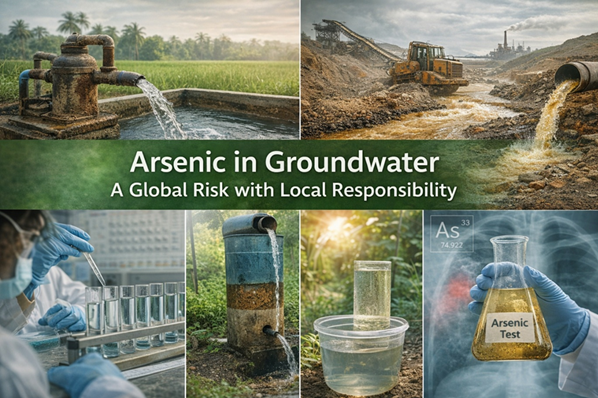
Arsenic contamination in groundwater is one of the most underestimated environmental health risks globally. It is invisible, tasteless, and often undetected until serious health impacts emerge. What makes arsenic uniquely challenging is that it originates from both natural geology and human activity, requiring differentiated risk management and clear accountability.
Understanding the source is not an academic exercise—it directly influences regulation, remediation strategy, and liability.
Natural vs. Human Sources of Arsenic
Geogenic (Natural) Arsenic In many regions, arsenic is released naturally from arsenic-bearing rocks and sediments into groundwater, particularly under low-oxygen (reducing) conditions. This phenomenon is widespread and well-documented across South and Southeast Asia, including Bangladesh,
India, Nepal, Vietnam, and parts of China. In these cases, contamination is often diffuse and affects shallow aquifers used for drinking water.
Anthropogenic (Human-Driven) Arsenic Human activity can significantly amplify arsenic contamination. Mining, metal smelting, coal combustion, chemical manufacturing, and historic pesticide use are common contributors. Poorly managed tailings, ash disposal, and industrial wastewater can create highly concentrated arsenic plumes, typically localized around industrial zones. Here, responsibility and remediation obligations are far more explicit.
Why Arsenic in Drinking Water Is a Critical Risk
Chronic exposure to arsenic is strongly linked to cancers (skin, lung, bladder), cardiovascular disease, neurological impairment, and severe skin disorders. The global burden remains alarming—over 200 million people are estimated to consume drinking water above safe arsenic limits.
The risk is compounded by perception: arsenic-contaminated water often appears clean, tastes normal, and gives no immediate warning signs. Without testing, exposure can persist for decades. From a governance perspective, distinguishing whether contamination is natural or industrial is essential for assigning legal responsibility, designing mitigation programs, and securing funding.
Treatment and Control: From Household to System Level
Effective arsenic management is technically feasible—but must be context-specific:
· Iron-based adsorption filters provide low-cost, high-impact solutions for households and small communities.
· Oxidation followed by filtration enables community systems to convert arsenic into a removable form.
· Reverse osmosis (RO) offers high removal efficiency for urban and industrial applications, albeit with higher operational complexity.
· Deep aquifer switching allows avoidance of contaminated shallow groundwater in natural hotspot regions.
· Low-tech bio-sand and iron filters have proven effective in remote and low-resource settings across Asia and Africa.
The Strategic Takeaway
Arsenic in groundwater is a global problem—but responsibility is always local. Whether the driver is geology or industry, organizations and authorities must move beyond detection toward source differentiation, risk ownership, and long-term water security planning.
Clear data, appropriate technology, and governance alignment are the difference between chronic exposure and sustainable protection of public health.

