
ECHA’s new REACH authorisation consultation: four substances that could reshape product compliance in 2026+
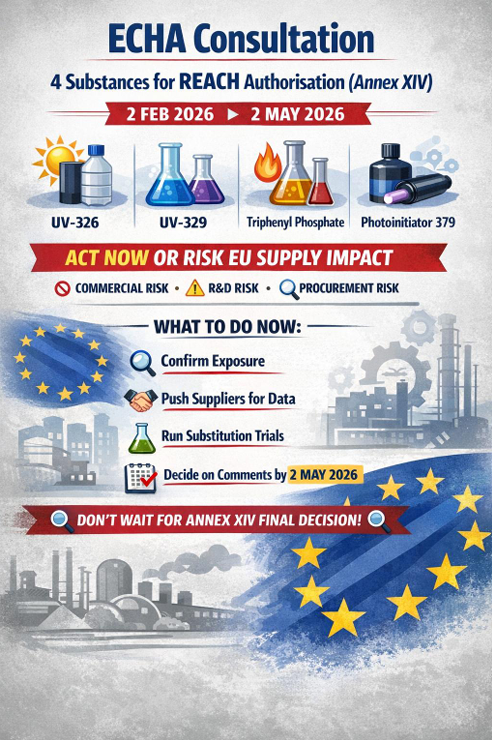
On 2 February 2026, European Chemicals Agency (ECHA) launched a public consultation on a draft recommendation to add four substances to the REACH Authorisation List (Annex XIV)—and invited stakeholders to submit comments by 2 May 2026.
This isn’t “just another regulatory update.” Annex XIV moves the conversation from “declare and manage” to “justify and substitute.” If your products, mixtures, or processes rely on any of the four substances—directly or via suppliers—this consultation is an early warning signal to tighten governance, validate alternatives, and protect EU market access.
What ECHA is doing—and why it matters
ECHA periodically recommends Candidate List substances for inclusion in Annex XIV (authorisation). When a substance ultimately lands in Annex XIV, continued use (for non-exempt uses) generally requires an authorisation—a formal permission to keep using the substance for specified uses under defined conditions.
Operationally, Annex XIV introduces two dates you must manage like business-critical milestones:
- Latest Application Date (LAD): the deadline by which an authorisation application must be submitted to keep using the substance past the sunset point.
- Sunset date: the date after which use and placing on the market must stop unless an authorisation is granted (or an exemption applies).
Regulators describe it plainly: the sunset date is the deadline after which use must stop unless authorised; Annex XIV entries may also include exemptions for certain uses.
Translation for business: if a substance ends up in Annex XIV and you don’t have a credible substitution or authorisation path, you risk a forced stop in EU supply.
The four substances under consultation (high-level)
Multiple industry summaries reporting on ECHA’s consultation identify the four substances as:
- Bumetrizole (UV-326) – commonly used as a UV stabiliser/UV absorber in plastics and coatings.
- UV-329 (often referenced as Octrizole / a benzotriazole UV absorber) – used as a UV stabiliser in plastics and related applications.
- Triphenyl phosphate (TPP) – used as a flame retardant and/or plasticiser in various polymer applications.
- Photoinitiator 379 (commonly referenced under a long chemical name) – used in UV-curing systems (e.g., inks/coatings/adhesives) as a photoinitiator.
Some sector reporting highlights that UV-326 and UV-329 are being treated as very persistent and very bioaccumulative (vPvB)—a red-flag hazard profile that typically drives substitution pressure.
Note: The official ECHA announcement page is the primary source, but it was not accessible to my browsing tool due to website blocking; the consultation dates are confirmed via indexed ECHA snippets, and substance naming/typical uses are corroborated across multiple industry summaries.
Why Annex XIV is different from “normal” REACH obligations
Most organisations are already juggling REACH obligations such as SDS quality, SVHC communication, and customer declarations. Annex XIV is different because it can force a strategic choice:
- Substitute (preferred outcome)
- Apply for authorisation (complex, evidence-heavy, and not guaranteed)
- Exit the EU market / redesign products (commercial impact)
Authorisation applications are not “paper exercises.” They typically require:
- a clear description of uses and exposure scenarios
- demonstration of risk control or socio-economic justification
- analysis of alternatives and a credible substitution plan
- supply-chain coordination (because upstream authorisations can cover downstream uses only if aligned)
Who should care (even outside the EU)
If you manufacture in the UAE/GCC (or anywhere else) and sell into the EU, you still need to care because:
- EU customers will push Annex XIV risk upstream fast (procurement won’t wait for legal deadlines).
- Product redesign cycles are long; UV stabilisers, flame retardants, and photoinitiators can be deeply embedded in formulations and performance claims.
- When an EU customer sees Annex XIV risk, they often trigger “no-surprises” controls: restricted substance clauses, immediate disclosure requests, and accelerated substitution roadmaps.
In short: Annex XIV risk becomes a commercial risk, not only a compliance risk.
What to do now: a practical 6-step playbook (no fluff)
1) Build a precise inventory (not just “we don’t think we use it”)
- Search across formulations, additives, masterbatches, curing systems, and legacy SKUs.
- Map where these substances appear: substance / mixture / article, and where in the value chain.
2) Trace supplier dependencies and demand evidence
Ask suppliers for:
- exact substance identity (CAS/EC where possible)
- concentration ranges
- use/function (e.g., UV stabiliser vs processing aid)
- availability of drop-in alternatives
- existing substitution programs and timelines
3) Segment your exposure by business criticality
Create a simple internal heatmap:
- High risk: high-volume products into EU + limited alternatives + tight performance specs
- Medium risk: alternatives exist but require qualification
- Low risk: easy substitution or minimal EU exposure
4) Launch “qualification sprints” for alternatives
For UV stabilisers / flame retardants / photoinitiators, qualification is rarely one-to-one. Plan for:
- performance validation (UV stability, yellowing, mechanical impact, curing performance)
- safety/regulatory profile of alternatives (don’t swap into the next SVHC)
- customer re-approvals (packaging/contact materials can be especially sensitive)
5) Decide whether you should submit consultation comments (by 2 May 2026)
ECHA explicitly invites comments by 2 May 2026.
If you have strong data on:
- essential uses
- lack of technically feasible alternatives
- disproportionate socio-economic impact
- realistic transition timelines
…then contributing can shape the final recommendation and downstream timelines.
6) Establish an “Annex XIV readiness” governance lane
Treat this like a mini-program with:
- an owner (Regulatory/Stewardship)
- cross-functional input (R&D, procurement, sales, QHSE)
- decision gates (substitute vs authorisation pathway)
- customer messaging pack (credible and consistent)
The leadership takeaway
This consultation is a signal that certain additive chemistries are moving into a higher-control regime. The winners won’t be the companies that “wait and see.” The winners will be the ones that:
- quantify their exposure fast,
- engage suppliers with clear data demands,
- run focused substitution trials,
- and communicate a credible transition plan to EU customers.
Source: https://echa.europa.eu/-/echa-consults-on-recommending-four-substances-for-reach-authorisation

